Saturday, 18 June 2011

Junior Parker - Love Ain't Nothin' But A Business Goin' On (1971)


Bluesman Junior Parker was born in Mississippi in 1932. As a teen he worked with and learned from some of the early greats of Blues music, from Sonny Boy Williamson to Howlin' Wolf to Bobby "Blue" Bland to B.B. King. Parker released a string of singles through the 50's and 60's, with many scoring well on the R&B charts. He died from a brain tumour in 1971, the same year that "Love Ain't Nothin'..." was released. The album - a real gem from start to finish - combines soul, funk and blues in a hip pot-pourri that avoids many of the clichés of other blues albums of the time. Parker's velvet-smooth, honeyed vocals shine through on the title track, along with "Outside Man" and "River's Invitation," while three Beatles covers - "Taxman," "Lady Madonna" and "Tomorrow Never Knows" - are pure quality. Al Green, on his 1974 album "...Explores Your Mind," dedicated the song "Take Me To The River" to Parker, describing him as "a cousin of mine who's gone on, and we'd kinda like to carry on in his name." Strong tribute indeed!

Go to Discogs for album info:

CD available at Amazon:

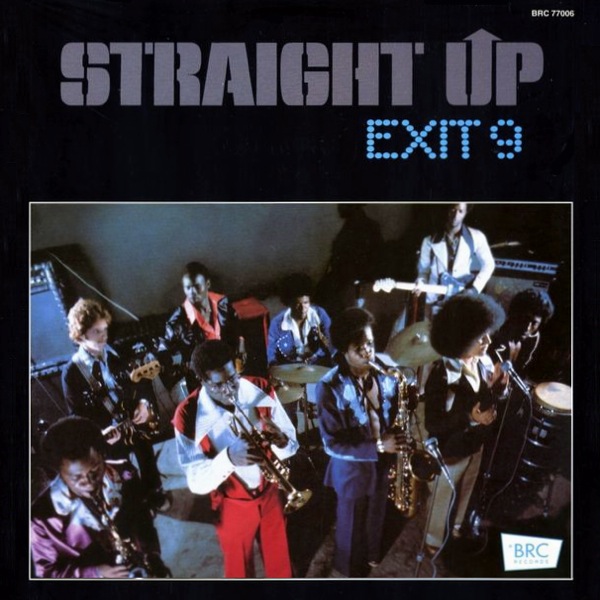
Exit 9 - Straight Up (1975)


"Straight Up" was the only album released by Exit 9, a nine-piece funk band out of New York. The group was a young one, with all members aged between of 16 and 20 when "Straight Up" was recorded. Originally called "Qualified Funk", the group built a reputation as a solid soul/rock outfit. A few months before this album was recorded, the group signed on with new managers, John Jenkins and Modeste Clark, changed their name to Exit 9, and shifted to a more dance music approach, with funky rhythms, strong melodies, tight brass, and guitars adding a raw edge to many of the songs. "Miss Funky Fox," an upbeat dancefloor favourite, is probably the best known track, but the entire album is strong, with highlights including the title track and "Jive Man," both infectious, up tempo groovers, and the mellow "Thoughts Of You." Exit 9's sound has been compared to pre-disco Bohannon and early Kool And The Gang - heady company to say the least! No wonder "Straight Up" is so popular with crate diggers and groove junkies!

Album information on Discogs:

Find it on Amazon:
(amazon.com) Straight Up
(amazon.ca) Straight Up
(amazon.co.uk) Straight Up

Thursday, 16 June 2011

Gil Scott-Heron & Brian Jackson - Winter In America (1974)


For all that Brian Jackson played a large part in his first 3 albums, Gil Scott Heron's 4th album, "Winter In America," was the first to be released with both musicians' names on the cover. Like "Pieces Of A Man," this is a solid, cohesive effort, with not a weak track to be found. The two standout tracks are "H2Ogate Blues," a stinging commentary on Tricky Dick Nixon's second term as president, and the stellar "The Bottle," a grooving, lyrical and powerful anti-alcohol warning. This is another highlight of Heron's ouvre, and together with "Pieces Of A Man," a great place to start a collection of his works.

Album info. from Discogs:

CD available from Amazon:
(amazon.com) Winter In America
(amazon.co.uk) Winter In America

Saturday, 11 June 2011

Gil Scott-Heron - Free Will (1972)


Gil Scott-Heron's third album is something of a mishmash of the first two - part confrontational, spoken word, rhythmic poetry, and part soul-jazz-funk-blues musical genius. On Side 1 - the music side - Gil, backed by many of the same musicians as on "Pieces Of A Man," excels. The title track, "The Get Out Of The Ghetto Blues," "Speed Kills" and "Did You Hear What They Said?" are all classics. Side 2 is a mixed bag, ranging from the blunt, paranoid conspiracy theory of "The King Alfred Plan" to the simple and subtle "Billy Green Is Dead" to the tongue-in-cheek flippancy of "Sex Education: Ghetto Style." Overall a bit of a mixed bag, but still a strong effort with typical Scott-Heron inventiveness and insight.

Check out Discogs for album info:

Available on Import CD from Amazon:
(amazon.com) Free Will

Sunday, 5 June 2011

Gil Scott-Heron - Pieces Of A Man (1971)


Gil Scott-Heron's second album, "Pieces Of A Man," was far more musical than his minimalist, poetic debut. Backed up by a bevy of talented musicians, including Ron Carter, Bernard "Pretty" Purdie, Hubert Laws, and soon-to-be main collaborator Brian Jackson, the album was quite possibly his most cohesive and accessible. Of Scott-Heron's voice, Carter would later say, "He wasn't a great singer, but with that voice, if he whispered it would have been dynamic. It was a voice like you would have for Shakespeare." Dynamic and full of feeling certainly applies to this collection, with not a weak piece to be heard. My fave's include the reworked "The Revolution Will Not Be Televised," the biting, honest "Home Is Where The Hatred Is," and the haunting "Pieces Of A Man." If you're a fan of Gil Scott-Heron, you probably have this already; if not, this is as good a place to start appreciating his genius!

On to Discogs for album info:

Gil Scott-Heron - Small Talk At 125th And Lenox (1970)


Gil Scott-Heron died just over a week ago, on May 27th, 2011. One of THE black musical pioneers of the 70's, his death passed almost as a footnote; I didn't learn of his passing until several days later when "R.I.P." posts of his better known albums suddenly started appearing on other blogs. Out of the limelight since the early 80's, it's hardly surprising that his end went almost unnoticed; at the same time, the loss of the man many consider the father of Rap and Hip Hop (a title Scott-Heron actively avoided) should probably have received greater coverage. As a high school and college student in the 60's, Scott-Heron studied writing and poetry, and it was through these media that he first garnered attention. He first gave serious consideration to music as a medium for expression in 1969, after the Last Poets played a concert at his university, and in 1970, his debut album, "Small Talk..." was released. Mostly spoken-word, in a live setting and with minimal accompaniment, the album took on varied themes, from the hypocrisy of many black "revolutionaries," to the superficiality of TV and mass consumerism, to the ignorance of the white middle classes regarding difficulties faced in inner-city ghettos. Highlights included "The Revolution Will Not Be Televised," possibly his best known song, along with the title track, "Enough" and "Everyday". This album is hard to find on CD - hopefully his passing brings Scott-Heron's music renewed attention, and a re-issue of his catalogue.

Album information on Discogs:

Saturday, 28 May 2011

Syl Johnson - Is It Because I'm Black (1970)


"Is It Because I'm Black" is yet another candidate for the "Best Album I Never Heard" prize. At the time of release, Syl Johnson had been living and recording in the Chicago area for several years. Like many black artists of the time, his writing often took on social issues such as poverty and equality, and with this album, these themes became a unifying focus, to the extent that "Is It Because I'm Black" is considered by some to be the first black, political concept album, and a precursor to such classics as Marvin Gaye's "What's Going On" and Sly & The Family Stone's "There's A Riot Going On." The title track is a drawn out, bluesy, gritty groover, with Syl pleading the case for his race. The song reached #11 on the R&B charts, and was also a minor hit on the Pop charts. "Concrete Jungle," another highlight that broke the R&B top 30, draws parallels between the black experience and that of Native Americans, with the difference being location of their reservations. The album closes strongly with "Right On," a rambling, energetic funk masterpiece. Definitely worth a listen, if you can find it.

Album info. on Discogs:

Available as part of 2-for-1 CD on Amazon:

Monday, 23 May 2011

Brass Construction - Brass Construction (1975)


Brass Construction, originally known as Dynamic Soul, came together in Brooklyn in 1968. They were signed by United Artists in 1975, with their self-titled debut released later that year. Although the funk ensemble recorded at an album-a-year pace over the next decade, "Brass Construction" almost certainly counts as their most successful collection. Brass Construction's dance-funk sound was centred on the horn section, though most songs also featured vocals. The standout track here is the first single, "Movin'," a catchy, energetic, up-tempo dance number that would be the group's only chart topper (reaching #1 on the US R&B chart in 1976). The follow-up, "Changin'," also did well, reaching #24, while "Love" and "Dance" were also strong efforts. The group would only crack the top 10 again once, with the single "Ha Cha Cha" from their second album reaching #8 on the R&B chart in 1977.

Discogs page for album info:

CD available on Amazon:
(amazon.com) Brass Construction
(amazon.ca) Brass Construction
(amazon.co.uk) Brass Construction

Tom Scott & The L.A. Express - Tom Cat (1975)


"Tom Cat" was the second album for the brief-lived Tom Scott & The L.A. Express. Larry Carlton and Joe Sample left after the recording of the group's debut and the sessions backing up Joni Mitchell on her "Court And Spark" album. Robben Ford took over from Carlton on Guitars, and Larry Nash replaced Sample as pianist. "Tom Cat" proved popular and sold well. Highlight tracks included "Rock Island Rocket," "Tom Cat," "Keep On Doin' It" and "Refried." Scott left the band to perform solo after this album, after which the remaining L.A. Express recorded two more albums before calling it quits.

Info. from Discogs:

CD available from Amazon Marketplace:
(amazon.com) Tom Cat
(amazon.ca) Tom Cat
(amazon.co.uk) Tom Cat

Tom Scott & The L.A. Express - Tom Scott & The L.A. Express (1974)


Saxophonist Tom Scott is probably best known for his TV series compositions, including the theme songs for "Starsky & Hutch" and "The Streets of San Francisco." As a teen, Tom led a jazz ensemble called the Neoteric Trio. He was also a "first-call" (high demand) session musician. Over the course of his career, on top of his own solo and lead work, he played back-up to the likes of the Grateful Dead, Joni Mitchell, Steely Dan, Pink Floyd and Quincy Jones, among others. In 1973, the L.A. Express formed as Tom's backing band. The original lineup featured Max Bennett, John Guerin, Larry Carlton and Joe Sample. This group was short-lived, recording the album "Tom Scott & The L.A. Express" and playing back-up on a number of tracks on Joni Mitchell's "Court And Spark" album. By the time the group's second album "Tom Cat" was recorded, Carlton and Sample had left. The songs on "Tom Scott & The L.A. Express" are all jazz funk instrumentals, with a heavy sax emphasis. Highlights include "L.A. Express," "Strut Your Stuff" and "Sneakin' In The Back" (from which the opening bass riff was sampled by Massive Attack for the song "Blue Lines").

Album info. available on Discogs:

Available from Amazon Marketplace: